Friday, August 20, 2010

Tubing in Vang Vieng, Laos

The 5 hour minibus ride to Vang Vieng was well, for lack of a better word, insane.  If we didn't hear the wheels skid around each turn, we were going too slow.  Our driver considered himself the Laotian version of Dale Earnhardt and took us around mind bending 180 hair pin turns as if we were the Starship Enterprise entering warp speed to escape the cling-ons.  Off the ever-crumbling side of the roadway was a deep deep ,but beautiful valley, which I pictured the bus being hurled into since there was no railing.  We couldn't decide whether it was better to close your eyes and not see death coming or to be prepared for a death roll and brace for it.  We ran over multiple live animals and almost took out an entire village as our driver made his best attempt to break the sound barrier.  I jokingly asked if we could go back and pick up the chicken that we'd flattened so as to save a few bucks on dinner, but I all got was a sort of gruff "bwah" sound, which I guess meant the answer was no.

Arriving in Vang Vieng, we were greeted with some rather obnoxious (read blood alcohol content of 2.0) English folks singing and stumbling down the street.  Vang Vieng, a town literally in the middle of nowhere, in a country in the middle of nowhere can be defined as southeast Asia's Cancun.  While the scenery is beautiful, the town is completely centered around a new "sport" called tubing.

Tubing consists of renting a tractor tire inner tube and hiring a tuk-tuk to take you upstream.  From there you deposit yourself into the river and prepare to have fun.  The float down the river would probably take about 1 hour at full speed, but due to the stops and "recreation time" at the numerous bars on the river, it takes about 4-6 hours depending on how much you fancy blaring techno and slurring obnoxious folks all wearing the same souvenir t-shirts proclaiming there descent of the river.  Our tolerance level was set at about 4 hours, but they had some amazing (and very sketchy) bamboo towers with rope swings that kept our attention.


Along the sides of the river, there are about 10 different bars, each advertising their own array of swings, ziplines, waterslides, etc. The local Lao workers have ropes that they throw out to you and pull you in with.  It's a great setup and I'm sure they're making plenty of money off of it.  The river s surrounded by yet again, more beautiful mountain landscape, and it's definitely an ironic mix of natural beauty and spring break debauchery. Lots of music, drinks, and water activities made for a fun day, but a few days were enough for us.


After the tubing, we'd had enough and decided to rent some bikes to explore some of the other surroundings.  We drove into a small Hmong Village where we were stared at by little kids as they peeped their heads from behind doors.  We also ended up talking to a local Hmong kid who spoke really good English and said we were welcome to explore around the village.

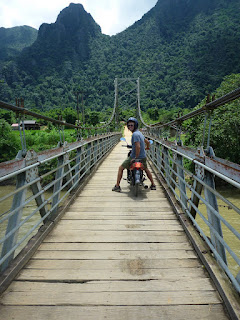
Later we checked out some caves and some natural springs.  That's about it for Vang Vieng.  Mostly just a stop for us in between Luang Prabang and Vientiane for a few days, but man, was the scenery beautiful  See for yourself.


Leaving Luang Prabang

I am almost 2 weeks behind on the blog now due to our faster pace of travel and my tiredness from continuously keeping it updated...so I'm borrowing some info. from my travel buddy, Jacob's blog until I can get caught back up.  I'm also glazing over many of the details of what happened and not worrying about how anything sounds so please forgive me... 

After taking the slow boat down the Mekong to Luang Prabang we spent a few days relaxing and exploring this Unesco protected World Heritage city.  The town is completely the opposite of anything you'd expect to find in Laos, at least in my mind.  French influenced architecture, food, and some awesome bakeries fill the town.  A lot of the town actually reminded us of our home town in Charleston. Originally we were going to rent dirt bikes so we could explore the country side, but this proved to be difficult and expensive. After one afternoon of speaking to local tourist companies and dealerships, I started getting the impression that bike rental was discouraged due to the local tourism office wanting us to pay for the local taxi services. Anyhow, we changed our plans and decided to relax in Luang Prabang for a couple days, then head to Vang Viene for some tubing down a river and cave exploration, then to Vientiane (Laos' french capital) to fly out to Hanoi, Vietnam so we could get dirt bikes there. This cuts our trip a little short in Laos but allows us to extend the time in Vietnam. To try to relax from the frustration, we rented some beach cruiser style bicycles and grabbed some cold beers for a leisurely pedal around the town. 


While exploring the town we ran into an UXO (unexploded ordinance) museum that was really interesting.  We learned about the 'Secret War' going on in Laos that wasn't made public until sometime later in the 70's.  Apparently, Laos is the most heavily bombed country in the world and it continues to affect the Laotians even to this day.  Below is an excerpt I pulled from Lonely Planet to briefly explain the history during the Vietnam war.

In 1964 the US began its air war over Laos, with strafing and bombing of communist positions on the Plain of Jars. As North Vietnamese infiltration picked up along the Ho Chi Minh Trail, bombing was extended the length of Laos. According to official figures, the US dropped 2,093,100 tons of bombs on 580,944 sorties. The total cost was US$7.2 billion, or US$2 million a day for nine years. No one knows how many people died, but one-third of the population of 2.1 million became internal refugees.

A large portion (they estimate some 30%) of the bombs dropped on Laos did not explode leaving millions of unexploded bombs (technically called bombies) all over Laos.  This has made the land very difficult and expensive to farm, develop, and improve.  It's really a sad thing to hear about and they say that every day someone is injured by an unexploded ordinance.  Many of the small bombs are round and look like toys children.  Many, many children and adults have died or are missing limbs.  Many of the farmers are so poor that they try and salvage the bombs for there scrap metal, which often results in dire consequences.  The museum was really interesting and gave us some good insight on the damage that was inflicted on the people, and it was saddening to see how they're still being effected.

Collection of UXO's

One night we met a Malaysian guy (Andrew) who was in the room next to us. He spoke great English (in addition to 5 other languages), and he joined us at the local pub for some (Tower Beers).
They were the cheapest drink out, and pretty cool looking. We rode our bikes to the pub, in the rain and when the pub closed Jake offered to give Andrew a ride (the bikes had a seat that you could sit on above the rear wheel), which obviously sounds like a bad idea from the start. Things were going pretty well (although I'm sure Jake had things completely under control in his mind), until he missed a turn. Andrew shouted "There it is", and about 3/4 the way past it he tried to make a quick turn. The bike slipped out like they'd run hit a banana peel, and they both spilled...laughing. Luckily no one was hurt. Jake offered Andrew another ride and he said "I would rather walk"...which no one could blame him for. Jake then preceded to get back on the bike and continued riding down the right road. Before we got back to the Guesthouse, he tried to bunny hop off of a curb...and the bike did the same thing...slipped out....adding a nice ding to his upper thigh.  "All part of the experience," he said. Andrew then suggested that "maybe Jake should walk too"...He agreed and made it home fairly unscathed.

The next day we ended up renting two scooters from a local restaurant for $15 (3x more than in Thailand) and going to some really interesting waterfalls. They had a cool rope swing and also a small waterfall that we could jump off of. We were soon joined by a busload of Buddhist monk children, that were soon jumping off the waterfall and rope swing with us. It was great seeing them in a relaxed state since we always see them marching around town with such serious faces. 


We are now leaving on a small bus for the 6hr trip to Vang Viene...

Friday, August 13, 2010

Laos - Land of One Million Elephants

Communist Laos flung open its doors to tourism in the early 1990s and the last decade has witnessed an explosion in development. To be honest though, I had never even heard of Laos until I started planning the trip and looking at maps of Southeast Asia.  With it's mountainous terrain and more laid back pace, it sounded like it would be a good place for our next stop.


We left Chiang Mai, Thailand for Laos on a 2nd class bus which took 5 hours to get to Chiang Rai. We then had to catch the last bus in Chiang Rai leaving for the border town of Chiang Khong at 5 pm. The bus arrived at the station at 4:45pm, and when we went to buy a ticket to Chiang Khong, they told us that we had to go to another bus station across town. If we missed this bus it was going to put us back another day, so we hustled, caught a tuk-tuk, and made it to the other bus station at 5:10...luckily the buses never leave on time and we got on just before it left. The 3rd class bus ride was slow, but went through beautiful countryside. When we got to Chiang Khong, we caught another tuk-tuk and had him take us to Bamboo Guesthouse, which was recommended in the Lonely Planet book. When we got there, the place seemed semi-shady, but the room looked clean (although it was made of thatch and looked like it would fall down if I sneezed too hard), so we trusted Lonely Planet and took it. This is where our interesting night started...


In preparation for our trip to Laos, we read in our guidebook about the 2 day journey down the Mekong on a long and extremely slow boat, which required an overnight stay in a village along the river.  The accommodation in the village was supposed to be very basic with limited power, but worst of all, reports of "rats the size of beagles" inside some of the guesthouses.  As we prepared ourselves mentally for what might lie ahead in the coming days, we thought of the likelihood that these same mega-rats could potentially be in the same area where we were staying that night.  "No worries," we told ourselves.  "We are men and can handle it."  The more we looked at the holes in the ceiling and walls of our basic thatched hut, the more our confidence in ourselves dwindled. 
Our vision of a Beagle Sized Rat


That night in Chang Kong will be a night neither Jake nor I will ever forget.  About an hour before we cut the lights out for the night, we heard something scurrying up a tree outside the room.  Then a large thump as something heavy sounding landed on top of the ceiling.  "Holy explicative," we said, "What was that?"  It sounded large enough to be a dog, but we couldn't tell exactly what it was.  I assured Jake (and myself) that surely it wasn't the dreaded beagle rat and more than likely it was probably just a cat...since rats don't climb trees, right?  I'd been through rats in the ceiling before in Borneo so I was sure we could handle it without any worries this time.

We listened for a while as we heard something scurrying around above the ceiling.  We banged on the ceiling a few times and the noises subsided for a while.  Not wanting to seem like sissies, we both laughed it off and said that we would sleep with one eye open. I then turned the lights (the room was pitch black...couldn't see a thing), and we proceeded to drift off to sleep with visions of mega-rats in our heads.

And then it began again, but worse this time.  Heavy scratching sounds followed by eerie hissing/squeaking noises began on the ceiling above.  We both woke with tense nerves and the hair on our necks stood like two feral cats in a street fight (well, not mine, but Jake was terrified).  Then we heard the creature running back and forth thumping around heavily up above.  We turned on the lights and banged on the ceiling a few more times while yelling a few Thai explicatives at whatever it was since it probably didn't speak much English.  The noises stopped and somehow we managed to drift off to sleep again.

As we slept, the unimaginable finally happened.  A noise more violent and louder than all the others pounded down hard on the ceiling and a few seconds later as I lay there asleep something large and warm and furry fell from above onto my back.  Even though I was still deep in an almost delusional sleep, my senses were in commando mode.  While my mind was still in a state of innocuous sleep, my body reacted like a trained military forces agent.  I sprang to my feet on top of the bed like Rambo except the only difference between a commando and me was that I was screaming louder than Little Richard at his farewell performance and high stepping faster than any NFL prospect at the combine.

Feeling the warm fur running around in the bed, I jumped down to the floor where I continued yelling and cursing and furiously practicing my high steps.  Meanwhile, Jake hadn't had a chance to make contact with the beast, but was obviously panic stricken by the fact that the room was pitch black dark and I was screaming, "AHHHHH it's on meeeee.  It's on meeee, dude." 

Feeling what I thought was the massive rodent on the floor now, I hurled myself back up onto the bed and Jake and I both continued yelling and dancing like school girls.  Not wanting to touch the floor, we scrambled for a flash light and shown it around the room.  Unfortunately, I drew the short straw and had to be the one to look under the bed.  Jake envisioned that the beagle rat would come out and naw my face off, but luckily that wasn't the case. 

We knew he was in the room somewhere, but didn't know where. I got off the bed and turned on the light...nothing was there... but the noises above started again and even louder than before. We were both white with fear, and didnt know what to do at that point. I didn't have any scratches or bites, and we didnt know what just happened. After pondering leaving, we decided it was best to try to tough it out and go back to sleep. The noises continued until morning, and we both jumped every time something made a noise in the room. Neither of us slept a wink, and decided to leave at 6 am to get out of there. We later discussed the incident over food and beers and to this day are not sure what truly happened. Our best guess was that when Jake tried to wake me up, he hit me which made me think a rat had fallen, then he must have hit my leg... who knows... funny story though.


Slow Boat to Luang Prabang


The slow boat
The slow boat to Luang Prabang Laos down the Mekong River was pretty cool. The oriental style polished teak boat was great to see, and even better to be going down the river on. Although the boat was slow and moderately uncomfortable, the scenery was beautiful.  But back to the uncomfortable... the boat had two options for seating... the floor which was preferred or VIP seating or wooden bench seats. (Mind you that the boat ride consisted of (2) 8hr days). As we started down the river, Jake and I started scoping out where we could hang our hammocks from. We found some good ceiling joists and got them situated so we were partially hanging out over the side of the boat above the water... this was not only a great view but also had a nice breeze.


Despite the "I hate you and hope your hammock breaks and you fall in the water and drown" looks from the other uncomfortable passengers, we managed to rub it in a little more by breaking out a couple Big Beer Lao's to sip on.  It was an incredibly relaxing first day.  Day # 2, the rug was pulled out from beneath both of us... for some reason we changed boats. The new boats didn't have joists that we could hang the hammocks from and we were forced out of the super VIP hammock section into the wooden seats with the masses. Day 2 was a backbreaker, however we met two cool Canadians (Dave and Jan) that helped pass the time.
The Mekong River had little signs of civilization, other than a few small river villages. The boat must have doubled as a supply boat, because it carried bags of rice, chicken cages, and other supplies on the roof which we dropped off at the small river towns. Most didn't have power lines or any signs of roads leading to them, so I assumed they were pretty isolated. We we arrived at our destination Luang Prabang, which was more of a town than a large city.  So far it is a really cool town that seems to have a lot of French influence (used to be a French colony).  Dave, Jan, Jake, and I walked into town and found a nice guest house with a large balcony and a river view. The guesthouse was a whopping $3 for each of us and had to be one of the most ornately decorated guesthouse of our trip.  The house was completely trimmed out in varnished teak with large planks of wood that would have to cost loads of money at home. So far, Luang Prabang seems like a cool place to spend a couple days.


View from the balcony of our room

Monday, August 2, 2010

Thailand - Bangkok, Chiang Mai, Mae Hong Son Loop by Motorcycle

Bangkok was as one would expect -- a major urban city buzzing with activity, with lots of characters, scams, temples, with same amount of energy as a locomotive trapped inside a glass bottle.  The political situation was calm and there were no signs of protesters or army officials, which is basically what we were told to expect before we arrived.

We took every method imaginable to get around the city from river rides, to the urban overhead sky-train, down below on the underground MRT (subway), on three-wheeled gas powered scam loving Tuk Tuks, and on foot.  Jake and I quickly decided Bangkok wasn't our scene, but we did check out a few of the major attractions while we were there. 

We checked out a few of the famous Wats, or temples as we would call them, a few savory markets, and went to one of the world's largest snake farms. The snake farm is a research facility where anti-venom is studied and created. We also got to see a couple of insaneThai guys play with cobras.

Since Bangkok is the sex change capital of the world, there was no way we could miss the sex change factory.  Jake even opted to turn into a girl for a day since it was so cheap...while in Rome they say. Only kidding. 

After a couple of nights in the Khao San flea pit (the main backpacker area) we decided to head north to Chiang Mai on an overnight sleeper train.  It was a great and new experience as well as being an efficient way to travel and save a day by traveling at night. 

Chiang Mai is revered by the Thai for its cultural heritage and its salute to the old way of living. For us, it was just a break from dirty Bangkok.  One night we decided to go to a Mui Thai kickboxing match to watch a headline fight between a Myanmar and Thai guy.  Most of these guys were tiny, but had huge legs and threw some impressive blows.

Jake and I were joking as to whether we would get into the ring with these guys (the weight classes started at around 120lb and ended at 160lb), and after watching a few high kicks we were both like "no way" (little did I know that before the end of the night, Jake would enter the ring for two rounds). Later we spoke to one of the 130 lb kick boxers, and joked about getting into the ring... he said "no problem...I go see," and asked the ring announcer.  For 400 baht ($12) he lined Jake up for the next fight. After having several beers and some Thai rum, I knew better and was not about to let the liquid courage convince me that I could take a trained Thai kickboxer (even if he was 5ft 7in.), especially in my current state. 

Jake had some training and boxing experience and was eager to test his skills against one of the Thais so I made him sign his will over to me before entering the ring. Jake and the fighter agreed on the conditions: No Kicks, No elbows, No knees, and big gloves. I think he assumed Jake was going to be an in-experienced tourist, but figured out pretty quickly that he knew how to box. I have a good feeling that if there were kicks, elbows, and knees, Jake might have two black eyes and a concussion right now...but amazingly, he was able to go both rounds, dropping him on two separate occasions, and finish him off with an impressive flurry of jabs, crosses, and uppercuts. Pretty neat experience, crowd was into it, and not many can say that they got into a ring with a Muay Thai kickboxer for 2 rounds...especially to put the hammer down like Jake did.  Truely impressive.  Here's a video of the finish: http://www.youtube.com/watch?v=kUVCvUQ3dhQ

After doing some research on things to do in northern Thailand, Jake and I came across the Mae Hong Son loop, which is said to be one of South East Asia's motorcylce riding meccas.  The loop is probably the most popular riding route in Thailand.  Almost 600 km in total, the Mae Hong Son loop is also known as the road of 1000 hairpin bends. Besides exhilarating turns on well-paved roads, the loop passes through scenic mountain regions blessed with points of interest such as caves, waterfalls, national parks, hot springs, temples and hill tribe villages. 

Mae Hong Son Loop
This sounded like exactly the type of trip we needed to help us escape the heat and hustle of over-hyped Bangkok.  Anyhow, Jake and I found some "motorcyles", well in the US they are actually mopeds...but here 125cc is as large as you need and there are a lot smaller bikes all over the road.

Traffic here is interesting... driving on the left takes some getting used to mentally, and just the chaos of the road is daunting. Motorcycles can go between cars while stopped, and when you are driving it seems like there are always 10 thai motorcyclers zooming past you on all sides. Interesting to say the least. But they are definitely the way to get around.

 Our route took us counterclockwise from Chiang Mai to the laid back hippy enclave of Pai, then onto Mae Hong Son, and later skirting the Myanmar (formerly Burma) border to Mai Sariang, and finally back to Chiang Mai.  Northern Thailand was at one time well known for its large role in the world's opium trade, but has since substituted other cash crops in place of the poppy flower.  I bet the local farmers were excited when they found out they had to trade in their poppy plants for legit crops. 

The route from Chiang Mai to Mae Hong Son was built during WWII by the Japanese, who forced villagers to complete the road to allow better access to neighboring Burma. Burma was occupied by the British at the time and was later attackd by the Japanese.  Interesting stuff.

The Mae Hong Son loop provides a good opportunity to visit North Thailand’s rugged north-west frontier. This region of Thailand is also home to the famous Karen hill tribe. If the name does not ring a bell, the images of women with long necks adorned with brass rings would probably be more familiar.

Pai - Our first stop

During our first day in Pai, we went riding through the countryside to a local canyon which had some neatly carved out mountain tops used as trails.We then went to an elephant camp (elephants were a large part of the Thai culture and workforce before machines were popular) and were able to take the elephants down to the local stream and play. They were huge and the one they let us ride was even more massive than the others.


To get up on the elephant they lifted us up with their trunk onto their head and then we climbed the rest of the way up. The ride was basically bareback (on a small blanket), and quite scary as we had to be 8-10 ft up since there's nothing to hold onto.


Our elephant was constantly eating any plants it could find on the way to the stream and was playful when we got there.  We took turns sitting near his head and the trainer would yell a command for him to either spray us with water from his trunk or throw us off.  We got to feed the elephants as well, which basically felt like being groped by a wet vacuum cleaner. Pretty wild...
Getting tossed by an elephant is as fun as it looks

The food in Thailand is some of the best I've ever tasted without even exaggerating.  And this is coming from a guy who ate only PB&J's until I was 20 and started eating salad just a few years ago.  Jake and I decided to try a cooking class to learn how to prepare some of our favorite local meals in hopes of impressing our lady friends back home.  

First, we took a trip to a local market to gather the many ingredients.  The market had all kinds of food from fried chickens (including the heads, feet, you name it), to whole pig ears, wasp larvae, quail eggs, and lots of other vegetables, herbs, and spices.  We made 5 different dishes which included: Green Chicken Curry (the best), Tom Yam Soup (spicy prawn soup), Pad Thai, Stir-Fried veggies, and Sweet Sticky Rice with Coconut Milk and Mango for dessert.  It was ridiculously good and all made from scratch.  We discovered that we're such good cooks that we may even open our own Thai restaurant back home -- watch out Basil.     

Tomorrow we leave Pai to continue the rest of the loop which will take us only a few miles from the border with Burma.

Mae Hong Son to Mae Sariang and back to Chiang Mai


After two days in Pai,  we got back on the Mae Hong Son loop with the motorcycles and it was incredible. I had no idea that Northern Thailand would be such a motorcyclist's paradise. The roads were great by US standards, 1864 curves (perfect for the bikes... I have tons of video and pictures, but something is wrong with my camera at the moment and I'm unable to upload so here's a video from youtube http://www.youtube.com/watch?v=gwkcuGjz0rc ).
The scenery was incredible.  Flooded rice fields with the most vibrant greens I've ever seen, surrounded in tall mist covered mountains...amazing.  It was a bit rainy, and would rain hard at least once per day, but we had rain gear (thankfully I am the son of an ever-prepared father who has never ventured outside without rain gear) and were often dried out quickly. It was a bit cold when we got to the tops of the mountains (50's F), but other than that it was spectacular. We went from Pai to Mae Hong Son, then to Mae Sariang... the further we went the less tourists we saw. Mae Sariang the level of English speaking locals went way down. The towns were a mix of Thai and a local mountain people "Karen" who were refugees from Burma. 

Next we are on to Laos...we have to catch a couple buses to Chaing Khong, then taking a  2 day slow boat down the mighty mud filled Mekong river (Southeast Asia's largest river) to Laos (http://www.youtube.com/watch?v=jD6lqFRIOO4). The scenery is supposed to be great and there's no better way to see the country than a slow boat through the country's heart.  The only problem is that the boats are generally overcrowded and the painfully uncomfortable especially with our abnormally large (at least in Asia) western body frames.  The boat is filled with rows of tiny, straight back, wooden bench seats of which we'll spend a masochistic total of 16 hours sitting on.   However, being the clever lads that we are, we bought cheap hammocks to hang up for the ride.  Will give an update once we get to Luang Prabang in Laos.


Sunday, August 1, 2010

Malaysian Borneo - Mt. Kinabalu


Towering 13,435 feet above northern Borneo, Mt Kinabalu is the highest mountain in all of southeast Asia. Known as Gunung Kinabalu in Bahasa Malaysia, the mountain is quite unlike any other on earth, rising almost twice as high as its Crocker Range neighbors and culminating in a crown of wild granite spires. When the summit is visible (usually in the morning, before the clouds close in) the mountain literally demands your attention.

I had heard this mountain was the highlight of many people's trip to southeast Asia so I decided I had to see what climbing Mt. Kinabalu was all about.  The only problem was that it's so popular that people book 6 months to even a year in advance in order to obtain a climbing permit.  I was determined to obtain a permit and I would do almost anything it took to climb the mountain.  Many people laughed when I told them I hadn't booked in advance and said I wouldn't be able to climb the mountain, but this only fueled the fire.

I figured my best option was to go directly to the mountain and camp out at the park headquarters in hopes that someone would cancel their trip or to see if I could sneak in.  Staying inside the park is ridiciulously inflated and they charge around $50 a night (most of my accommodation has been no more than $5-10 per night) to sleep in a dorm.  If I was going to stick around the park for awhile, I'd have to find somewhere more reasonably priced.  I walked just outside the park and found a local home-stay where they only charged $7 per night, but the only problem was that there was no heat and I only had shorts and t-shirts, and the mountain air was freezing at night.  The other problem was that I heard noisy rats running around in the ceiling all night so I put a few more blankets over me and put
 in some ear plugs to drown out the rambling rats.   

The next morning, I walked back to the park headquarters with my "I'm sad and desperate" face and made my best attempt at charming the female park ranger.  Unfortunately, my nose must have not been big enough for her (Many of the Asians here apparently find big noses attractive), because she shot me down in under 2 seconds.  Luckily, I had emailed the park the day before asking them to let me know if their was a cancellation.  I asked if I could check my email and surprisingly, someone had canceled and their was 1 space available.  Awesome!  I had to scramble to get some gear ready to hike the mountain since I had virtually none of the stuff I would need.  I was able to rent some warm clothes, a head lamp, and  a poncho to keep me dry. 
The devils and me
I also found 2 nice couples that let me join them and share a guide.  The two couples were from Tazmania and planned to travel around Borneo together for several weeks.  They were a bit older than me which at first I thought would be awesome.  I thought I'd be able to take it nice and slow going up the mountain and that surely they would wus out before I did.  What I found out later was that one of the couples competed in ultra-marathons and ran 100 km races.  Just great, I thought, now I'll get smoked by the old folks.  (Sorry Dan, Kylie, Tom and Lynn...you're not really old folks, you're just older folks than me.)

The calf busting climb is usually completed in 2 days with an overnight stay at a small lodge near the top called Laban Rata.  You wake up around 2 am to finish the remainder of the climb and reach the summit by sunrise.  Mt. Kinabalu at sunrise is stunning to say the least.  One of the most beautiful sites I think I've ever seen.  You look over all of Borneo and can see out into the South China and Celebes Seas.  Simply humbling.

It was also great being the fifth wheel for 2 days with the Tazmanian couples.  They basically treated me like their son and refused to let me pay for anything.  I legitimately enjoyed hanging out with them and I would definitely hang out with them even more if I were to ever move to Taz.  After the mountain hike, we split ways and they went to the island of Sipidan to dive one of the world's best spots.  I was highly jealous since I didn't have the time (or the reservation) to dive there.

One other interesting person I met on the mountain was an English woman by the name of Roz Savage.  Roz quit her career as a management consultant in order to accomplish one of her dreams which was to be the first woman to row across the Pacific Ocean -- that's right, ROW, not sail, across the Pacific Ocean  Truly insane.  Roz has also rowed across the Atlantic and plans on doing the Indian in the near future.  She now works as an public speaker, a novelist, and an environmental advocate.   

After hiking the mountain, I headed to the capital of Sabah, the lively town of Kota Kinabalu, where I spent the next 5 days licking my wounds and moaning in pain from the soreness of hiking the mountain with ultra-marathon runners.  I didn't do too much here besides eat lots of really good fresh (and cheap!) seafood from the Phillipino fish market along with lots of ice cream.  I also watched movies at the huge air-conditioned shopping mall.  Glorious!

3 huge Tiger Prawns and 1 BBQ'ed tuna steak for a whopping $4

Friday, July 23, 2010

Malaysian Borneo - Swingin' in Sandakan

The mere mention of Borneo, as the Lonely Planet says, conjures up a host of vivid images: thick jungle teeming with wildlife, wild rivers flowing through tunnels of overhanging trees, orangutans swinging through forest canopy, craggy mountains soaring above the steamy lowlands, and remote longhouses inhabited by the descendants of head hunters.  Incredibly, all of these images are accurate.  You'll find this and more in Malaysian Borneo, but what is surprising are the prosperous cities  with first class resorts, efficient public transport, and an extensive network of paved roads.  Borneo - the world's 4th largest island, is located just east of peninsular Malaysia and is made up of two countries: Malaysia in the north and Indonesia in the south.

 I needed to find somewhere to occupy my time for the next week and a half until Jacob and I meet up so I decided to head to the northern state of Sabah in Borneo.  A nature lover's paradise, Sabah is the place to see some of Borneo's famed wildlife.  It's also home to one of the world's best dive sites, the uninhabited island of Palau Sipadan - a massive coral fringed oceananic pinnacle in the Celebes Sea.  But, the main reason I came to Borneo was to climb the craggy peaks of Mt. Kinabalu, the 13,435 foot freak of a mountain that dominates Borneo's northern landscape with its twin granite peaks. 

After researching the ridiculous bureaucratic requirements involved with climbing the mountain (apparently people book a permit as early as 1 year in advance), I decided to first fly to Sandakan, a city four hours east of the mountain to spend more time figuring out how to reserve a permit to climb.  Since I only had 10 days time before I flew out of Borneo to meet Jacob, timing was an issue.

Sandankan is a city with an interesting past.  It was once a thriving port heavily involved in the timber industry that depleted much of northern Borneo's forestry.  Surprisingly, Sandakan used to be the home of the world's highest concentration of millionaires.  This is no longer the case as I would find out from a local that befriended me at the airport.
I arrived in Sandakan late at night, not exactly sure of how I would get to the town center.  After I got off the plane, I ended up talking to a local guy from Sandakan that lived and worked in Kuala Lumpur.  He asked me how I was getting to town and I said I'd probably take the bus.  He insisted that he and his family give me a ride into town.  I was hesitant at first, but when I met his elderly mother and the rest of his family, I felt a bit more comfortable. 

CT, as he liked to be called was a Chinese Malaysian and had been educated in London.  He spoke with a British accent, which I never expected to hear coming from a Chinese guy.  It appeared CT's family had profited substantially from the logging industry since he along with his three brothers had all been educated in England.  CT explained that he owned his own business in KL, but was visiting home to see his sick father in the hospital.

CT dropped me off at a hostel in the city center and walked inside to make sure the place looked ok.  He gave me his card and told me he'd be happy to show me around the town after he visited his father the next day.  I thanked him for his offer and the ride and he left.

The next day, I visited the Sepilok Orangutan Rehabilitation Center, one of only four orangutan sanctuaries in the world.  At 10 AM each day, they feed the orangs a tray full of........(you'll never guess)................bananas and milk, what a surprise.  It was an awesome experience to see these endearing and freakishly human-like creatures up close (especially since I was still bitter about my like of animal sitings in Taman Negara).  Their movements are clearly that of a primate's, but their facial expressions make it seem that they clearly have some emotional intelligence. 


The rehab center's goal is to take injured and orphaned orangs and nurse them back to health.  This involves training them how to climb and find food on their own, which I thought would obviously be instinctive.  Surprisingly, baby orangs must be taught to climb and find food and if their mothers aren't around to teach them, they won't survive on their own.  Some orangs in the center take as long as 10 years before they are capable of surviving on their own and others never even leave.  But, in my opinion, and with my vast knowledge about orangutan habits, I think the link between humans and orangutans is even closer than we know.  The situation is similar to our welfare system in that there are always those orangutans that exploit the program and live off the government cheese or in this case, free milk and bananas.  So apparently, political issues exist even in the confines of an orangutan sanctuary. 
Government Cheese


Later that day, I received a call at the hostel from CT to go for lunch and a tour of the city.  CT took me to lunch where I was introduced to some local food that included chicken and deer satay, which is basically schiscobobs with some fresh peanut sauce.  We also tried a cool dessert made of partially frozen milk, fresh fruit, jelly, and strangely, soy beans - an interesting, but tasty mix.  CT refused to let me pay for lunch and I thanked him graciously.  We later drove all over the city where he pointed out where he grew up and the areas that were heavily developed for the logging industry.  CT explained how the town was essentially a wild, rugged cowboy town back in the boom days where rough uneducated men suddenly became rich by stumbling into the logging business. 

Shortly after the the timber industry took off, the town began to rapidly develop and expand with huge hotels, casinos, bars, and night clubs - hence the highest concentration of millionaires.  This is all much different than it looks today though.  Once the timber started to run out and the government finally stepped in by putting restrictions on the industry, the town began to burn out.  Today, Sandakan is a faded boom town with many abandoned and dilapidated buildings.  Not exactly the most charming city, but travelers mostly use it as a base camp for outdoor related excursions.

Some Spaniards and I with CT
Later that night, I met CT along with some friends I'd met at the hostel for a drink along the harbor.  He took us all in his car to a lookout above the city and later, a famous British tea house, once occupied by some famous author I cared nothing about...nice of him to do anyways.  CT's hospitality was very unexpected and I was wary at first since we don't usually have people that friendly back home.  In the end, he ended up being a nice and genuine guy who was interested in learning about me and showing me his city.  

 After researching my options for hiking Mt. Kinabalu, I decided my best chances of hiking the mountain would be to go directly to the headquarters at the base of the mountain and do whatever it took to get a permit, whether it meant begging, sneaking, bribing, or selling my soul (not all of it, but maybe just part of it).

Saturday, July 17, 2010

Lombok to Bali to Malaysia

I updated my last post with a story about the rooster fight in Lombock, so scroll down to where you see "***Updated***" in the "Back to Lombok" post if you care to read.  I've also posted a good many more pictures under the picture section for the Gili Islands, Lombok, Uluwatu (in Bali), and my latest pictures of Malaysia.

We spent the remainder of our days in Indonesia in Bali trying desperately to find any waves to surf.  On our last day before we left, the waves finally arrived and the swell jumped from 5 feet to 13 feet in one day!  We got up early and surfed Kuta Reef with around 100 over zealous surfers who had also been waiting eagerly for the swell to show up.  There were some huge waves coming through and many people were getting barrels, but with so many people in the lineup it got pretty dangerous.  Later that day we headed to Uluwatu, the famous surf break, where we knew the waves would be even bigger.

Jed had to leave to go back home and we said our goodbyes before I left for my early morning flight.  Jed has been a great travel partner and an even better friend.  I was lucky to have someone like him to share the adventures with and I wish he could have stayed on longer.  Good luck back home, Jed, and I can't wait to get back and relive our stories!

I've been in Malyasia since July 12 and spent the first 2 days in the capital city, Kuala Lumpur.  The city is similar to Singapore, but not nearly as clean.  The people are interesting and most are friendly, but not nearly as friendly as the people of Bali and Lombok.  I spent my first day exploring the city and checked out the Petronas Towers.  The two massive towers are the headquarters for the Petronas oil company are a truly a sight to behold.  The first 5 to 6 stories consist of a huge shopping mall with more stores and people than I've ever seen in a mall, so needless to say I didn't spend much time there.  I spent most of my first day alone without talking to a soul since there seemed to be hardly any tourists around Chinatown, where I was staying. I ate dinner that night by myself and a local Chinese man sitting next to me began talking with me.  I ended up moving over to his table and talking over dinner with him about the U.S. and where I was from.

After dinner, he invited me for a walk around the town and showed me some areas of interest.  Hong, was a retired economics professor and principal who proudly told me about how he'd worked for 34 years with only 4 sick days.  Hong and I talked about many things like the way children should be raised and how they needed discipline.  We walked around for about 3 hours and I ended up buying him one of the local fruit drinks.  Hong was a nice guy and I'm glad I had the chance to talk with him.

On my flight over from Indonesia, I met a German guy named Sevor, who had been traveling the world for the past 9 months.  He'd lived in Australia, working and studying, and traveled to Hawaii, Fiji, and some other remote islands in the South Pacific in search of surf.  We were trying to figure out what we were going to do in Malaysia and decided we would travel together to Taman Negara, Malaysia's oldest national park, where we hoped to trek around in the jungle and see some wildlife.

The jungles of Taman Negara are a buzzing, leech-infested mass of primary forest over 130 million years old. While we were there we decided to give something back so we decided to give blood to the locals -- and by locals, I mean leeches.  To get to Taman Negara, we took a 5 hour bus ride followed by a 3 hour journey by boat up river to Kuala Tahan, the base camp for Taman Negara.  On our first day, we hiked 15 miles into the jungle towards a hide (a primitive jungle hut) where we would stay the night and try to see the Asiatic Sun Bear or a tapir.

Hiking in the jungle could be compared to putting a wet plastic bag over your body and blowing a hair dryer inside to make sure things are warm enough.  Throw in a few thirsty leeches, about 12 billion finger sized monster ants, 9 different species of ultra-venomous snakes, and some of the most dense vegetation imaginable, and you can picture what I'm talking about.  I counted over 20 leeches around my ankles and legs and my shoes were soaked with blood at the end of the hike.  And I am positive I have never sweated that much in my life.  Every square inch of clothing was soaking wet, but hey, that's what we asked for right? Not really.  On our trek, we scrambled up steep trails, over twisted roots and forged our way across rivers.  I learned that Sevor went to school to be a physicist, but after finishing his bachelors, decided to take a year long break to explore the world.  He was a great guy and we had some interesting philosophical conversations about life -- because what else is there to do when you're trekking through the jungle?

After hiking for about 3 hours and not seeing any more trail markers, we began to get a little bit worried.  Judging by the scale on our map, we should have crossed a river and made it to our hide by now.  We kept thinking we might have made a wrong turn somewhere and the guide at the headquarters (who we turned down because we're men and real men don't need guides) told us to be careful not to wonder off the path because aborigines that live in the forest have their own trails.  What!?  People actually live in this hell hole, we thought?  Sevor and I had to make a decision.  Should we turn back now and walk through the night to get back to the base camp by 11 pm or keep going and try to find the hide?  We decided to walk another hour in the direction we thought the hide was in.  After an hour had passed, there was still no sign of the river or the hide.  Crikey.  I told Sevor I thought we should walk 10 more minutes and if we didn't see any signs for the hide, we'd turn back and make the brutal hike back in the dark.  We really, really, really didn't want to hike back in the dark and we especially didn't want to sleep on the jungle floor after seeing the Jurassic Park sized ants and millipedes.  After 5 minutes more of walking, we finally came across the river and trail marker!  Relief!

We crossed the river and finally made it to the hide where we spent the night with 10 other people.  These other people (we'll call them the "cheaters") had arrived at the hide by boat, which took a measly 2 hours and a lot less effort.  We slaved our way through the jungle for 8 hours and looked ragged and war-torn.  We were jealous of their dry clothes and lack of leech bites.  We spent the night there and saw not one single damn animal.  Ahhhh!  It was an experience though, hearing the jungle come alive as the millions of animals started making their night noises.  The animals were so loud you could barely hear yourself talk.  It was also cool to think about where I was, on the other side of the world in Malaysia, in the middle of the jungle, 30 feet above the ground with 10 other people from all over the world, who I've never met.

The next day we hiked back a different way on the trail that the guide at the lodge told us was the "flat" way.  He must have mixed up the trails because the trail back this day was even worse than the day before.  Up and down steep slippery root-knotted trails for another 8 hours.  After 6 hours, I'd finally had enough and trekked down to the river where I hired a boat driver to take me back to the base camp.  I was done with the jungle!

The next day Sevor and I headed back to Kuala Lumpur where we would split ways.  He was heading to Bangkok to meet friends and I am heading to the city of Sandakan on the island of Borneo to see some orangutans, do some diving, and hopefully climb the highest peak in southeast Asia, Mt. Kinabalu (approx. 12,000 ft.)